Was tun, wenn du in deinem eigenen Haus ständig Bedrohungen und Gewalt ausgesetzt bist und die Polizei nicht dafür da ist, dich zu schützen?
Yasmin* wird seit Jahren in ihrem eigenen Haus rassistisch bedroht und angegriffen. Die Polizei nimmt sie nicht ernst, die Wohnungsbaugesellschaft schaut weg. Für ihre Anwältin und einen Umzug braucht sie Geld und ist auf Spenden angewiesen.
Was ist passiert?
Yasmin lebt seit einigen Jahren in einer Mietwohnung einer öffentlichen Wohnungsbaugesellschaft. Seit längerer Zeit erlebt sie dort Bedrohungen und Gewalt durch Nachbar*innen. Sie berichtet von Stalking durch eine Nachbarin. Diese lauert ihr vor der Tür auf und bedroht sie rassistisch und macht davon Videoaufnahmen. Ein anderer Nachbar bedroht sie ebenfalls, sperrte sie bereits aus dem Haus aus, und von dessen Bekannten wurde sie geschlagen.
Keine Hilfe von Polizei und Justiz
Wegen dieser Gewalt hat Yasmin oft die Polizei gerufen und Strafanzeigen gestellt. Anfangs in der Hoffnung, dass die Polizei hilft, die Gewalt zu beenden. Inzwischen nur noch aus Verzweiflung, weil sie schmerzlich erfahren musste, dass die Polizei nichts für sie tut. Weder Polizei noch Staatsanwaltschaft nehmen sie ernst. Bei Notrufen erscheinen die Beamt*innen teilweise gar nicht mehr. Sobald ihre Personalien abgerufen werden, ändert sich ihr Verhalten: Yasmins Name ist bekannt, aber sie weiß nicht, was in ihrer Akte steht. Ein Auskunft über die Akte wurde ihr bis jetzt nicht gewährt. Wir gehen davon aus, dass sie durch Markierungen wie „Vielmelderin” oder „Nachbarschaftsstreiterei” vorverurteilt wird. Ohne Einsicht gibt es für sie keine Möglichkeit, dagegen vorzugehen und sich zu entkriminalisieren.
Die Polizei unterstützt sie nicht, im Gegenteil: Sie stellt Yasmin als jemanden dar, der „übertreibe”, und wimmelt sie mit dem Hinweis auf einen „Nachbarschaftsstreit” ab, mit Ratschlägen wie „Ziehen Sie doch um”. Doch alle, die den Wohnungsmarkt in deutschen Großstädten kennen, wissen, was es bedeutet, eine bezahlbare Wohnung finden zu müssen. Vor allem für Menschen, die nicht weiß sind.
Dass Yasmin umziehen muss, ist ihr längst klar. Das hat sie der Wohnungsbaugesellschaft schon vor Jahren mitgeteilt. Doch diese entzieht sich der Verantwortung und bietet trotz jahrelanger Kenntnis der Situation keine Alternative zu rassistischer Bedrohung und Schikane. Eine andere Stelle, die diese Lage beenden könnte, gibt es nicht. Antidiskriminierungsstellen oder andere Beratungsstellen sind nicht in der Lage wirksame Maßnahmen zu ergreifen.
Alles, was Yasmin bleibt, ist eine seit Jahren andauernde Auseinandersetzung mit Justiz- und Polizeibehörden. Dabei ist sie notgedrungen zur Expertin für Gesetze und Polizeiverfahren geworden. Zugang zu Gerechtigkeit hat ihr das bisher nicht verschafft. Die Gewalt, die sie als migrantisierte Frau im Haus erfährt, setzt sich dadurch nur weiter fort.
Kein Einzelfall, sondern ein Muster
Was Yasmin erlebt, ist kein Versagen einzelner Beamt*innen. Wer Gewalt meldet und nicht ins Bild des „glaubwürdigen Opfers” passt, wird selbst zum Problem gemacht. Aus der Betroffenen wird die „Vielmelderin”, aus rassistischer Bedrohung ein „Nachbarschaftsstreit”, aus dem Anspruch auf Schutz der lachhafte Ratschlag, doch einfach wegzuziehen. Die Verantwortung wandert von der Polizei zur Staatsanwaltschaft zur Wohnungsbaugesellschaft und landet am Ende wieder bei Yasmin.
Das ist keine Panne, die sich mit besserer Schulung beheben ließe. Polizei ist darauf ausgerichtet, Ordnung durchzusetzen, Eigentum zu schützen und Menschen zu kontrollieren. Nicht darauf, Konflikte zu lösen oder Sicherheit für alle Menschen zu schaffen. Für Menschen, die rassistisch markiert werden, heißt das oft: Sie gelten bei der Polizei als Risiko denn als schutzbedürftig. Aus unserer langjährigen Begleitung von Betroffenen rassistischer Polizeigewalt kennen wir dieses Muster: nicht ernst genommen werden, Täter-Opfer-Umkehr, Kriminalisierung der Betroffenen.
Was Yasmin gebraucht hätte, ist keine weitere Streife. Sie hätte gebraucht: eine Wohnungsbaugesellschaft, die handelt und ihr zügig eine sichere Wohnung anbietet. Eine Nachbarschaft, die Rassismus nicht hinnimmt. Anlaufstellen, die ihr glauben und echte Maßnahmen ergreifen können. Genau diese Strukturen fehlen. Deshalb sind sie nicht vom Staat zu erwarten, sondern müssen von uns aufgebaut werden: durch gegenseitige Unterstützung, Öffentlichkeit und Solidarität.
Warum Yasmin trotzdem juristisch vorgeht
Yasmin spürt eine tiefe Wut über die Untätigkeit von Polizei und Vermieterin. Mittlerweile hat sie eine Anwältin, in der Hoffnung, dass ihre Situation dadurch ernster genommen wird. Das ist kein Widerspruch zur Kritik an Polizei und Justiz: Solange es keine anderen Strukturen gibt, bleibt ihr nur, sich innerhalb dieses Systems zu wehren, auch wenn sie ihm nicht traut. Das kostet Geld, das sie nicht hat. Der Schritt, das Geschehene öffentlich zu machen, ist ihr nicht leicht gefallen. Sie geht ihn, weil sie keine andere Wahl sieht. Deshalb sammeln wird Geld für Yasmins Anwaltskosten und, sobald eine neue Wohnung gefunden ist, für die Kosten des Umzugs.
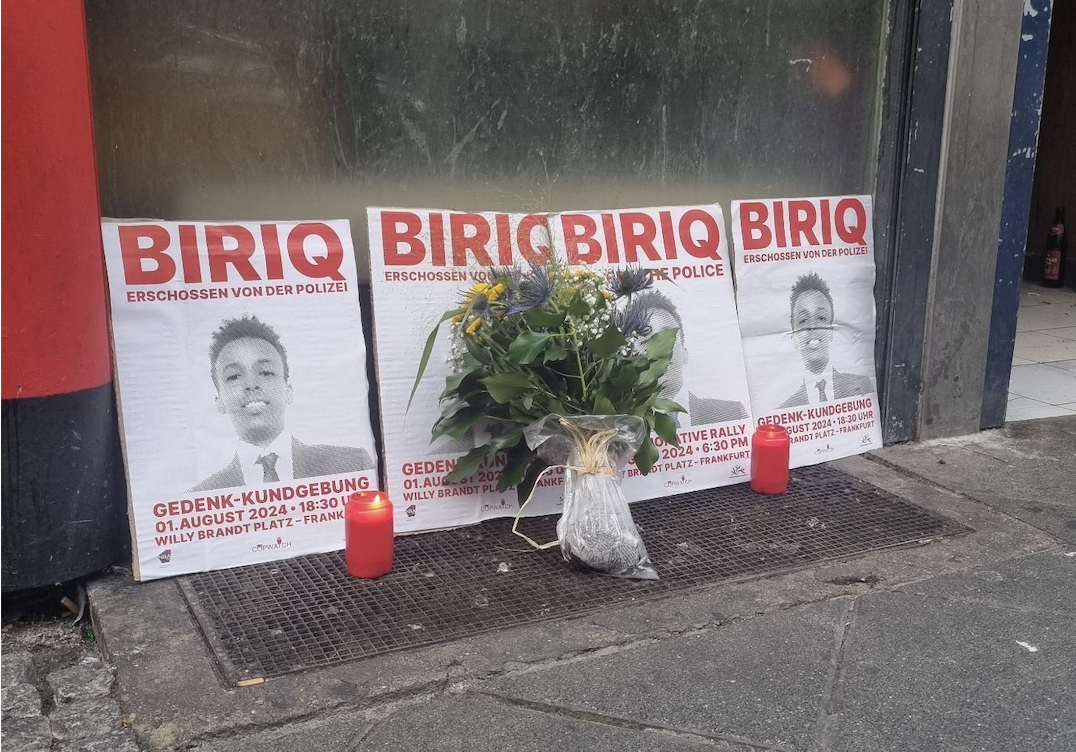
Im März 2026 hat das Oberlandesgericht (OLG) nun auch das letzte juristische Mittel, das wir im Fall von Biriqs Ermordung gegen die Polizei einsetzen konnten, abgewiesen. Das OLG hält es somit anscheinend für überflüssig, das eskalative, brutale und tödliche Vorgehen der Polizei vor Gericht zu verhandeln. Biriq wurde von oben in den Kopf geschossen, während er am Boden lag. Was einer Hinrichtung gleicht, wird von der Justiz als Notwehr abgetan. Wir haben nichts anderes von diesem rassistischen Justizsystem erwartet und dennoch sind wir wütend!
Gericht übernimmt polizeiliche Narrative
Der Beschluss des OLG übernimmt die Darstellung der Polizist*innen klar und weigert sich vehement dagegen, fragwürdige polizeiliche Narrative zu hinterfragen. Auch wenn Beamt*innen bewusst falsche Aussagen gemacht hätten, „würde dies nicht per se dazu führen, dass den Angaben generell kein Glauben mehr geschenkt werden könnte“.
Das OLG argumentiert weiter, dass bei zeitlichem Druck nunmal die Rechtswidrigkeit des eigenen Handelns vorher nicht abgewogen und „bis in alle Einzelheiten“ geklärt werden könnte. Bei der Tatnacht geht es allerdings wenig um Einzelheiten und viel mehr um einen durch und durch gewaltvollen Polizeieinsatz, der nicht unter zeitlichem Druck passierte, sondern lange vorbereitet wurde und eine längst entschärfte Situation völlig unnötig eskalierte.
Im Beschluss wird außerdem ausgeführt, dass es irrelevant sei, dass der Einsatz, bei welchem Biriq getötet wurde, rechtswidrig war, weil Biriq diesen Einsatz trotzdem „zu dulden“ hatte. Wir sehen allerdings einen klaren Unterschied in der Duldung einer Festnahme und der Duldung seiner Ermordung!
Das Nachdenken über ein mögliches Alternativverhalten zum Einsatz von Schusswaffen wird im Bericht als „überhöhte Anforderung“ an die Beamt*innen betitelt und die Notwendigkeit der „Entlastung der Vollzugsbeamten“ vor rechtlichen Folgen für die Beamt*innen wird betont. Darauf, dass die besagte „Notwehrlage“ ohne den rechtswidrigen Einsatz garnicht erst zustande gekommen wäre, wird allerdings nicht weiter eingegangen.
Dieses Urteil ist jedoch nicht überraschend: Die Justiz schützt die Polizei, da beide strukturell auf einer Seite stehen. Insofern können wir uns vor Gericht keine Gerechtigkeit erhoffen.
Was ist passiert?
Amin Farah, von seinen Freund*innen Biriq genannt, war ein junger somalischer Mann, der in der Nacht auf den 02. August 2022 von der Polizei im Frankfurter Bahnhofsviertel brutal erschossen wurde.
Die Polizei wurde aufgrund einer Bedrohungslage zum Hotel in dem sich Biriq befand gerufen. Vom Eintreffen der Beamten bis zu ihrem Handeln befand sich Biriq 3 Stunden alleine in seinem Zimmer, das von 80 Polizist*innen samt Spezialeinsatzkommando (SEK) umstellt war und stellte für niemanden eine Bedrohung dar.
Trotzdem greift die Polizei zu einem maximal eskalativen Vorgehen:
– Sie kommunizieren zu keinem Zeitpunkt mit Biriq, obwohl er deutsch sprach & zusätzlich Dolmetscher*innen vor Ort waren
– SEK Beamte brechen die Zimmertür mit einer Ramme auf, obwohl ihnen der Schlüssel vorlag
– Sie hetzen einen umarkierten Polizeihund auf Biriq, der ihn direkt angreift und sich in seinen Arm verbeißt
– Anschließend stürmen die SEK-Beamten das Zimmer und geben sechs Schüsse aus nächster Nähe ab, davon treffen 2 Schüsse von oben in den Kopf und die Schulter, was bedeutet, dass Biriq zu diesem Zeitpunkt schon am Boden lag
Das ist keine Notwehr sondern eine regelrechte Hinrichtung!
Dennoch hielt es die Staatsanwaltschaft nicht für nötig, eine Anklage gegen die Polizeibeamten zu erheben.
Ermittlungen und das fehlende Gerichtsverfahren
Abdiwali Farah, den Bruder von Biriq, der in Äthiopien lebt, hat gegen diese Entscheidung der Staatsanwaltschaft Beschwerde eingelegt. Die Beschwerde wurde dann von der Generalstaatsanwaltschaft verworfen und wir haben Abdiwali dabei unterstützt den letzten strafrechtlichen Weg – nämlich die Klageerzwingung – einzureichen. Das Oberlandesgericht (OLG) musste sich dann mit dem Fall befassen.
Die beauftragte Anwältin Beate Böhler hält den gesamten Polizeieinsatz für unverhältnismäßig und spricht von einer „Kette von Fehlentscheidungen“. Sie geht nicht von Notwehr aus. Insbesondere der wohl tödliche Schuss, aus kurzer Distanz senkrecht in Biriqs Kopf, passt nicht dazu. Das Schussgutachten, das die Staatsanwaltschaft vorgelegt hat, lässt viele Fragen offen, etwa in welcher Reihenfolge die Schüsse genau abgegeben wurden. Diese Ungereimtheiten wurden im Klageerzwingungs-Schreiben benannt und aufgelistet.
Abdiwali konnte und wollte nicht nachvollziehen, wieso es bei einem so brutalen und eskalativen Vorgehen der Polizei nicht einmal zu einer Verhandlung vor Gericht kommt. Er forderte in die Verhandlung des Todes seines Bruders mit einbezogen zu werden:
„I would like to request to be a part of the debate of the death of my brother in Germany. I just would like to be present when the death case of my brother is opened in court in Germany. We as a family we need justice and transparency about the circumstances of my brother’s death from the German government.“
Diese Transparenz wurde Biriqs Familie verwehrt. Denn nun wurde im März 2026 auch das Klageerzwingungsverfahren abgewiesen, ohne dass ein Verfahren vor Gericht eröffnet und das Vorgehen der Polizei auch nur verhandelt wurde. Das OLG schließt sich der „Notwehr“ Theorie der Polizei und Staatsanwaltschaft an.
„Notwehr“ stellt hier eine dreiste Lüge dar. Nicht nur waren die SEK-Beamt*innen besonders gut geschützt: mit schusssicherer Weste und stichsicherem Kettenhemd kann ihnen kaum etwas bedrohlich werden.
Aber auch sonst sagt die Juristin Beate Böhler, dass eben genau das Gegenteil der Fall ist: „Den Hund auf Biriq loszulassen, stellt sich als rechtswidrige gefährliche Körperverletzung dar, gegen die ihm ein Notwehrrecht zustand“. Biriq befand sich also selbst in eine Notwehrlage.
Das soll Gerechtigkeit sein?
Die fehlende Aufarbeitung und die vielen Ungereimtheiten des polizeilichen und gerichtlichen Narrativs zeigen deutlich, dass die Polizei frei von Konsequenzen agieren, lügen und sogar töten kann und dabei von Staat, großen Teilen der Gesellschaft und Presse gedeckt wird. Während immer mehr Fälle von Polizeigewalt von Frankfurter Polizist*innen bekannt und skandilisiert werden, werden die Täter*innen jedoch meist geschützt, bleiben anonym und ungestraft. So ist auch die Identität des Polizisten, der Biriq tötete weiterhin unbekannt.
Biriqs Tötung reiht sich ein, in eine Vielzahl von Fällen rassistischer Polizeigewalt. Alleine in der Woche, in der Biriq getötet wurde, starben 3 weitere Menschen durch die Hand des deutschen Staates. Alle von ihnen waren Schwarz oder migrantisiert. Besonders Schwarze Menschen und People of Color werden tagtäglich von der Polizei kontrolliert und schikaniert. Besonders in Vierteln wie dem Frankfurter Bahnhofsviertel sind rassistische Polizeipraktiken an der Tagesordnung. Racial profiling, Kontrollen und Schikane enden nicht selten in körperlicher Gewalt oder in Biriqs Fall sogar dem Tod. Ein gesellschaftlicher Aufschrei bleibt hier meist aus, wenn die Opfer prekarisiert oder in die Wohnungslosigkeit gedrängt leben.
Der Normalzustand von Überwachung und Kontrolle durch neue KI-Überwachungstechnologien und ständige Polizeipräsenz in Vierteln wie dem Bahnhofsvierteln, konstruiert bestimmte Menschen als konstante Bedrohung und dient als Legitimation für jegliche Gewalt gegen sie.
Somit werden Narrative wie die „Notwehr“-Lüge der Polizeiunhinterfragt von Staatsanwaltschaft und dem OLG übernommen und reproduziert.
Biriq wurde von einem rassistischen System ermordet, in dem die Justiz die Umstände schafft, unter denen die Polizei ungestraft tötet.
Es liegt an uns, Biriq zu erinnern, zu gedenken und aufzuzeigen, woran er gestorben ist. Denn Biriqs Fall zeigt uns abermals: Auf diesen Staat können wir uns nicht verlassen!
Und jetzt?
Nach dem Mord an Biriq gab es keine breite öffentliche Debatte, keine politische Verantwortung, keine gesellschaftliche Empörung.
Aber die Geschichte ist nicht vorbei, zumindest nicht für die, die zurückbleiben. Nicht für Biriqs Geschwister in Äthipoien. Nicht für die Menschen, die im selben Viertel leben; Menschen, die wissen, was die Konsequenz ihrer „Andersmarkierung“ sein kann.
Gerechtigkeit heißt für uns deshalb mehr als ein Gerichtsverfahren: Sie bedeutet, die Gewalt sichtbar zu machen, die Biriqs Leben und Sterben strukturiert hat, aber auch die Geschichten der Ermordeten zu erzählen und eine Gesellschaft einzufordern, die nicht länger akzeptiert, dass Schwarze, migrantische, arme oder anderweitig marginalisierte Menschen staatliche Gewalt erfahren. Gerechtigkeit bedeutet, die Systematik hinter der Gewalt zu erkennen und zu benennen.
Erinnern heißt kämpfen und Erinnerung ist Widerstand! Das heißt, dass wir Biriq und all den anderen Menschen gedenken müssen, deren Leben in diesem System als entbehrlich gelten und die ihm zum Opfer gefallen sind.
Biriqs Bruder, Abdiwali sagte letztes Jahr zum 3. Todestag:
„Es fühlt sich wie eine Depression an. Aber wir hoffen, dass uns eines Tages unsere Rechte gewährt werden. Ich bin sehr enttäuscht über die deutsche Justiz. Trotzdem werde ich bis zum letzten Moment meines Lebens für Gerechtigkeit kämpfen.“
Wir können seinen Schmerz nur erahnen, wollen ihn aber in diesem Kampf um Gerechtigkeit unterstützen!
Tatsächliche Gerechtigkeit können wir uns vom aktuellen staatlichen System nicht erhoffen; und solange wir keine Gerechtigkeit erhalten, dürfen wir dem System keinen Frieden lassen und müssen dagegen kämpfen: No Justice, no Peace!
––– English –––
Statement by the Solikreis Biriq on the Higher Regional Court’s decision to reject the order to file a lawsuit against Biriq’s killer
In March 2026, the Higher Regional Court (OLG) has now also dismissed the last legal measure we could pursue against the police in the case of Biriq’s murder. The OLG thus apparently considers it unnecessary to bring the police’s escalatory, brutal, and lethal actions before a court. Biriq was shot in the head from above while he was lying on the ground. What amounts to an execution is dismissed by the judiciary as self-defense. We expected nothing else from this racist judicial system, and yet we are furious!
Court Adopts Police Narrative
The Higher Regional Court’s ruling clearly adopts the police officers’ account and vehemently refuses to investigate the police’s questionable narrative. Even if officers had knowingly made false statements, “this would not in itself mean that their statements could no longer be generally trusted.”
The Higher Regional Court further argues that, under time pressure, the illegality of the officers actions in the night of the killing cannot be weighed beforehand or clarified “in every detail.” However, the night of the incident is less about details and much more about a thoroughly violent police operation that did not occur under time pressure but was prepared well in advance and completely unnecessarily escalated a situation that had long since been defused.
The ruling also states that it is irrelevant that the operation in which Biriq was killed was unlawful, because Biriq was nevertheless required to “tolerate” this operation. We, however, see a clear difference between tolerating an arrest and tolerating one’s own murder!
The report describes the consideration of possible alternatives to the use of firearms as an “excessive demand” on law enforcement officers and emphasizes the need to “relieve law enforcement officers” of legal consequences. However, the report does not address the fact that the so-called “self-defense situation” would not have arisen in the first place without the unlawful use of force.
This ruling is not surprising, however: The justice system protects the police, as both are structurally reliant on racism. In this respect, we cannot hope for justice in court.
What happened?
Amin Farah, known to his friends as Biriq, was a young Somali man who was brutally shot by police in Frankfurt’s Bahnhofs district on the night of August 2nd, 2022.
The police were called to the hotel where Biriq was staying due to a reported threat. From the time the officers arrived until they took action, Biriq spent three hours alone in his room, which was surrounded by 80 police officers, including a special operations unit (SEK), and posed no threat to anyone.
Nevertheless, the police resorted to an approach that escalated the situation to the maximum:
– They did not communicate with Biriq at any point, even though he spoke German and interpreters were present on site
– SWAT officers broke down the door with a battering ram, even though they had the key
– They set an unmarked police dog on Biriq, which immediately attacked him and bit into his arm
– The SWAT officers then stormed the room and fired six shots at point-blank range; two of these shots struck him from above in the head and shoulder, meaning that Biriq was already on the ground at that point
This is not self-defense but a outright execution!
Nevertheless, the prosecutor’s office did not deem it necessary to file charges against the police officers.
Investigations and the Lack of a Trial
Abdiwali Farah, Biriq’s brother who lives in Ethiopia, filed a complaint against the prosecutor’s office’s decision. The complaint was then rejected by the Attorney General’s Office, and we supported Abdiwali in filing the final legal recourse—namely, an order to compel prosecution. The Higher Regional Court (OLG) then had to hear the case.
Abdiwalis attorney, Beate Böhler, accuses the entire police operation of being disproportionate and refers to a “chain of wrong decisions.” She does not believe it was self-defense. In particular, the shot that likely proved fatal—fired at close range directly into Biriq’s head—does not fit that scenario. The forensic report submitted by the prosecution leaves many questions unanswered, such as the exact sequence in which the shots were fired. These inconsistencies were identified and listed in the letter requesting a trial.
Abdiwali could not and would not understand why, given such a brutal and escalatory police response, there isn’t even a trial in court. He demanded to be included in the proceedings regarding his brother’s death:
“I would like to request to be a part of the proceedings regarding my brother’s death in Germany. I just would like to be present when the case regarding my brother’s death is opened in court in Germany. We as a family need justice and transparency regarding the circumstances of my brother’s death from the German government.”
This transparency was denied to Biriq’s family. For now, in March 2026, the order to file a lawsuit against Biriqs Killers was also dismissed without a trial being opened in court or the police’s actions even being heard. The Higher Regional Court (OLG) concurs with the “self-defense” theory put forward by the police and the public prosecutor’s office.
“Self-defense” is a blatant lie in this case. Not only were the SWAT officers exceptionally well-protected—with bulletproof vests and stab-proof chain mail, they are practically immune to any threat.
But legal expert Beate Böhler also points out that the exact opposite is true: “Setting the dog on Biriq constitutes unlawful and dangerous bodily harm, against which he had a right to self-defense.” Biriq, therefore, found himself in a situation of self-defense.
Is this supposed to be justice?
The lack of accountability and the many inconsistencies in the police and judicial narrative clearly show that the police can act, lie, and even kill with impunity, while being shielded by the state, large segments of society, and the press. While more and more cases of police violence by Frankfurt police officers are coming to light, the perpetrators are usually protected, remain anonymous, and go unpunished. Thus, the identity of the police officer who killed Biriq also remains unknown.
Biriq’s killing is just one of many cases of racist police violence. In the week Biriq was killed alone, three other people died at the hands of the German state. All of them were Black or migrant. Black people and people of color, in particular, are controled and harassed by the police on a daily basis. Especially in neighborhoods like Frankfurt’s Bahnhofsviertel, racist police practices are the order of the day. Racial profiling, controls, and harassment often end in physical violence or, in Biriq’s case, even death. There is usually no public outcry when the victims live in precarious conditions or are forced into homelessness.
The normalization of surveillance and control through new AI surveillance technologies and a constant police presence in neighborhoods like the Bahnhofsviertel constructs certain people as a constant threat and serves as justification for any violence against them.
Thus, narratives such as the police’s lie of “self-defense” are unquestioningly adopted and reproduced by the public prosecutor’s office and the Higher Regional Court.
Biriq was murdered by a racist system in which the justice system creates the conditions under which the police kill with impunity.
It is up to us to remember Biriq, to commemorate him, and to expose the cause of his death. For Biriq’s case shows us once again: We cannot rely on this state!
And now?
After Biriq’s murder, there was no widespread public debate, no political accountability, no social outrage.
But the story isn’t over—at least not for those left behind. Not for Biriq’s siblings in Ethiopia. Not for the people who live in the same neighborhood; people who know what the consequences of being “marked as different” can be.
For us, therefore, justice means more than a court case: it means making visible the violence that shaped Biriq’s life and death, but also telling the stories of those who have been murdered and struggling for a society that no longer accepts that Black, migrant, poor, or otherwise marginalized people experience state violence. Justice means recognizing and naming the systemic nature of the violence.
To remember is to fight, and remembrance is resistance! This means that we must commemorate Biriq and all the other people whose lives are deemed expendable by this system and who have fallen victim to it.
Biriq’s brother, Abdiwali, said last year on the third anniversary of his death:
“It feels like depression. But we hope that one day our rights will be granted. I am very disappointed in the German justice system. Nevertheless, I will fight for justice until the very last moment of my life.”
We can only imagine his pain, but we want to support him in this fight for justice!
We cannot expect true justice from the current state system; and as long as we do not receive justice, we must not give the system any peace and must fight against it: No Justice, no Peace!
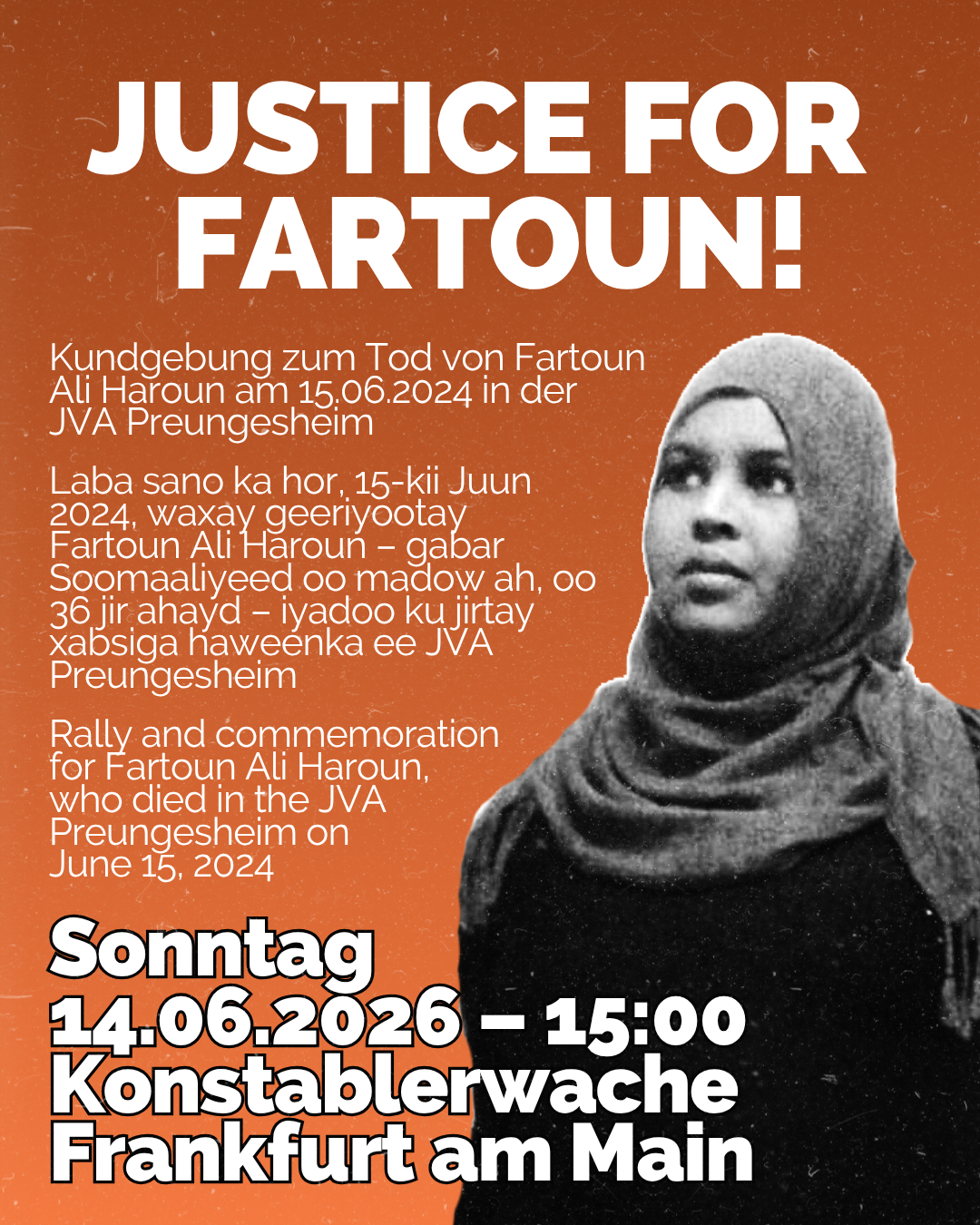
Vor zwei Jahren, am 15. Juni 2024, starb Fartoun Ali Haroun – eine junge Schwarze Frau aus Somalia im Alter von nur 36 Jahren – in der JVA Preungesheim. Sie starb, weil ihr die medizinische Hilfe verwehrt wurde, die sie dringend gebraucht hätte.
Ihre psychischen Probleme und der Verdacht auf paranoide Schizophrenie wurden nicht ernst genommen. Statt psychologischer Unterstützung wurde Fartoun inhaftiert. In der JVA verweigerte sie tagelang Nahrung und Flüssigkeit. Aufgrund ihres als „aggressiv“ bewerteten Verhaltens wurde sie von Justizbeamt*innen fixiert. Diese Kombination aus mangelnder Versorgung und Fixierung führte zur Bildung einer Thrombose, die letztlich eine tödliche Embolie verursachte. Obwohl Fartoun am Tag ihres Todes zweimal in ein Krankenhaus gebracht wurde, erhielt sie keine angemessene medizinische Behandlung – eine Behandlung, die ihr Leben hätte retten können.
Fartoun floh mit ihren Töchtern aus dem vom Bürgerkrieg zerrissenen Somalia, über Malta und die Niederlande, nach Deutschland – in der Hoffnung auf Sicherheit. Doch statt Schutz fand sie hier staatliche Gewalt, die ihr Leben beendete. Ihre Töchter befinden sich bis heute nicht bei ihrer Familie, sondern in der Obhut des Jugendamtes. Ihre Angehörigen kämpfen seit zwei Jahren für Aufklärung, Gerechtigkeit – und das Sorgerecht für die Kinder.
Am 14. Juni 2026 um 15 Uhr wollen wir an der Konstablerwache zusammenkommen – um Fartoun zu gedenken und gemeinsam Gerechtigkeit zu fordern.
Denn Gedenken heißt kämpfen – gegen einen rassistischen und ableistischen Staat und seine Institutionen!
Wir fordern: Aufklärung und Gerechtigkeit für Fartoun – und für alle Opfer staatlicher und polizeilicher Gewalt!
~ English version ~
Two years ago, on June 15, 2024, Fartoun Ali Haroun – a young Black woman from Somalia aged just 36 – died in Preungesheim Prison. She died because she was denied the medical help she urgently needed.
Her mental health problems and suspected paranoid schizophrenia were not taken seriously. Instead of psychological support, Fartoun was imprisoned. In prison, she refused food and fluids for days. She was restrained by prison officers due to her behavior, which was deemed “aggressive”. This combination of lack of care and being restraint led to the formation of a thrombosis, which ultimately caused a fatal embolism. Although Fartoun was taken to hospital twice on the day of her death, she did not receive adequate medical treatment – treatment that could have saved her life.
Fartoun fled with her daughters from civil war-torn Somalia, via Malta and the Netherlands, to Germany – hoping for safety. But instead of protection, she found state violence here, which ended her life. Her daughters are still not with their family, but in the care of the youth welfare office. Her relatives have been fighting for two years for clarification, justice – and custody of the children.
On June 14, 2026 at 3 p.m., we want to come together at Konstablerwache – to commemorate Fartoun and demand justice together.
Because remembering means fighting – against a racist and ableist state and its institutions!
We demand: Clarification and justice for Fartoun – and for all victims of state and police violence!
~ Somali version ~
Laba sano ka hor, 15-kii Juun 2024, waxaa xabsiga Preungesheim ku geeriyootay Fartoun Ali Haroun — haweeney madow oo dhalinyaro ah oo Soomaaliyeed, da’deeduna ahayd keliya 36 sano. Fartoun waxay u dhimatay sababtoo ah looma siin daryeel caafimaad oo ay si degdeg ah ugu baahnayd.
hibaatooyinkeeda dhanka maskaxda iyo tuhunka ku aaddan cudurka paranoia schizophrenia si dhab ah looma qaadin. Halkii laga siin lahaa taageero nafsi ah, Fartoun waxaa lagu xukumay xabsi. Intii ay xabsiga ku jirtay, waxay diidday cunno iyo cabitaan maalmo badan. Sababo la xiriira dabeecaddeeda oo lagu tilmaamay “mid gardarro ah”, shaqaalaha xabsigu waxay ku xireen si xoog ah (fixation). Isku-darka daryeel la’aanta iyo xariggaas ayaa sababay in ay dhaxalato dhiig-xire (thrombosis), taas oo keentay embolism (dhiig xirta halbowlaha), taas oo ugu dambeyn dishay. Inkasta oo Fartoun laba jeer loola cararay isbitaalka maalintii ay dhimatay, si dhab ah looma daaweyn – daryeelkaas oo badbaadin lahaa nolosheeda. Fartoun waxay dalka Soomaaliya uga carartay dagaalka, iyada iyo gabdhaheeda, waxayna soo martay Malta iyo Nederland, iyada oo u jeeddo ahaan u timid Jarmalka – si ay u hesho nabad iyo badbaado. Laakiin halkii ay ka heli lahayd ilaalin, waxay halkan ku la kulantay tacaddi dowladeed oo nolosheeda dhameeyey. Gabdhaheedii weli lama siinin qoyskeeda, waxayna gacanta ugu jiraan hay’adda daryeelka carruurta (Jugendamt). Qoyskeeda waxay laba sano u halgamayaan: runta, caddaaladda – iyo in carruurta loo celiyo qoyskooda. 14-ka Juun 2026 saacadda 3:00 galabnimo, waxaan dooneynaa inaan ku kulanno Konstablerwache — si aan u xusno Fartoun isla markaana si wadajir ah caddaalad ugu dalbanno.
Waayo: Xusuusasho macneheedu waa halgan – halgan ka dhan ah nidaam cunsuriyad iyo naafonimo takoorka ku dhisan iyo hay’adihiisa! Waxaan dalbaneynaa: run iyo caddaalad loo helo Fartoun – iyo dhammaan dhibbanayaasha rabshadaha dowladeed iyo booliska!
Staatliche Gewalt gegen die Bevölkerung, ob gegen Schwarze Menschen, Migrant*innen, Geflüchtete, Protestierende oder Menschen in psychischen Krisen, ist an so vielen Orten der Welt Normalität und sie bleibt fast immer ohne Konsequenzen. Laut Amnesty International werden jährlich ca. 19000 Menschen weltweit durch die Polizei getötet – die Dunkelziffer müsste jedoch weit höher liegen, weil diese Gewalt meist nicht genug dokumentiert wird.
Die Polizei wird uns so oft als Sicherheit verkauft oder dass sie notwendig wäre, um Kriminalität zu bekämpfen. Dabei ist sie vielmehr ein Mittel des Staats, um Unterdrückung und die herrschende Ordnung aufrechtzuerhalten, und dieser verübt dabei selbst kriminelle Gewalt: Proteste wie aktuell im Iran, in Kenia und Kamerun werden brutal niedergeschlagen, kurdische Personen vom syrischen Militär vertrieben und gefoltert, Migrant*innen in den USA oder Deutschland entführt und abgeschoben oder inhaftiert, BIPoC mit rassistischen Kontrollen schikaniert und Razzien enden tödlich – wie auch in Brasilien, wo im Jahr 2024 etwa 17 Menschen pro Tag durch die Polizei umgebracht wurden.
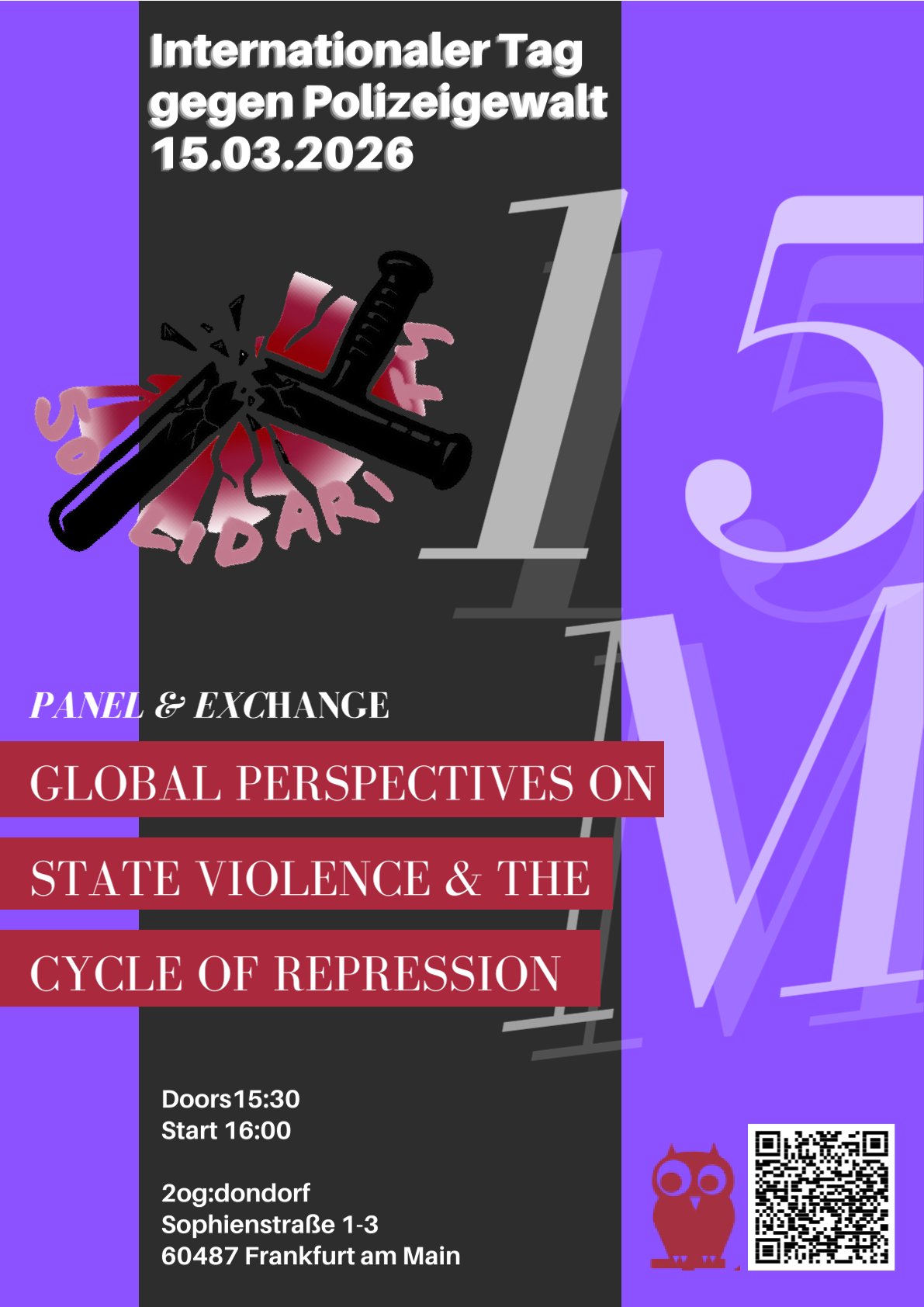
Zum Internationalen Tag gegen Polizeigewalt veranstaltet copwatch ffm eine Podiumsdiskussion zu internationalen Perspektiven auf Polizeigewalt und staatlicher Repression. Eingeladen sind Menschen aus verschiedenen Communities, die von Kämpfen, Repressionen und Strategien gegen Polizeigewalt in verschiedenen Kontexten berichten – genaueres wird in den nächsten Tagen hier auf unserem Instagram-Kanal nach und nach bekannt gegeben.
Nach der Podiumsdiskussion wird der Raum für einen Austausch geöffnet, um miteinander ins Gespräch zu kommen.
Die Veranstaltung findet auf Englisch statt – Flüsterübersetzung können wir nur gewährleisten, wenn wir vorher Bescheid wissen, also schreibt uns gerne eine PN (@copwatchffm) oder Mail (info@copwatchffm.org).
Die Veranstaltung findet hybrid statt. Das heißt, ihr könnt auch digital via einem Zoom Meeting teilnehmen. Der Link wird auf Anfrage verschickt.
Sagt euren Freund*innen Bescheid.<3
Save the Date:
Wann? –> Sonntag, 15. März 2026 ab 16 Uhr
Wo? –> @2og_dondorf
Es wird vor Ort fingerfood und Getränke gegen Spende geben.
Mehr Infos folgen.
March 15 – International Day Against Police Brutality
State violence against the population, whether against Black people, migrants, refugees, protesters, or people in mental health crises, is normal in so many places around the world and almost always goes unpunished. According to Amnesty International, approximately 19,000 people worldwide are killed by the police every year—but the actual number is likely to be much higher because this violence is usually not adequately documented. The police are often presented to us as synonymous with security or as necessary for fighting crime. In reality, however, it is a means for the state to maintain oppression and the prevailing order, and in doing so, it itself commits criminal violence: protests such as those currently taking place in Iran, Kenya, and Cameroon are brutally suppressed; Kurdish people are displaced and tortured by the Syrian military; migrants in the US or Germany are kidnapped and deported or imprisoned; BIPoC are harassed with racist checks, and raids end deadly – as in Brazil, where in 2024, about 17 people per day were killed by the police.
On the International Day Against Police Brutality, copwatch ffm is hosting a panel discussion on international perspectives on police violence and state repression. People from various communities are invited to report on struggles, repression, and strategies against police violence in different contexts. More details will be announced on our Instagram channel over the next few days.
After the panel discussion, the space will be open for an exchange to get into conversation with each other.
The event will be held in English—we can only guarantee whisper translation if we know in advance, so feel free to send us a private message (@copwatchffm) or email (info@copwatchffm.org).
And the event will also be hybrid. Which means you can attend digitally via a zoom link. The link will be provided upon request.
Tell your friends.<3
Save the Date:
When? –> Sunday, March 15, 2026, starting at 4 p.m.
Where? –> @2og_dondorf
Finger food and drinks will be available on site for a donation.
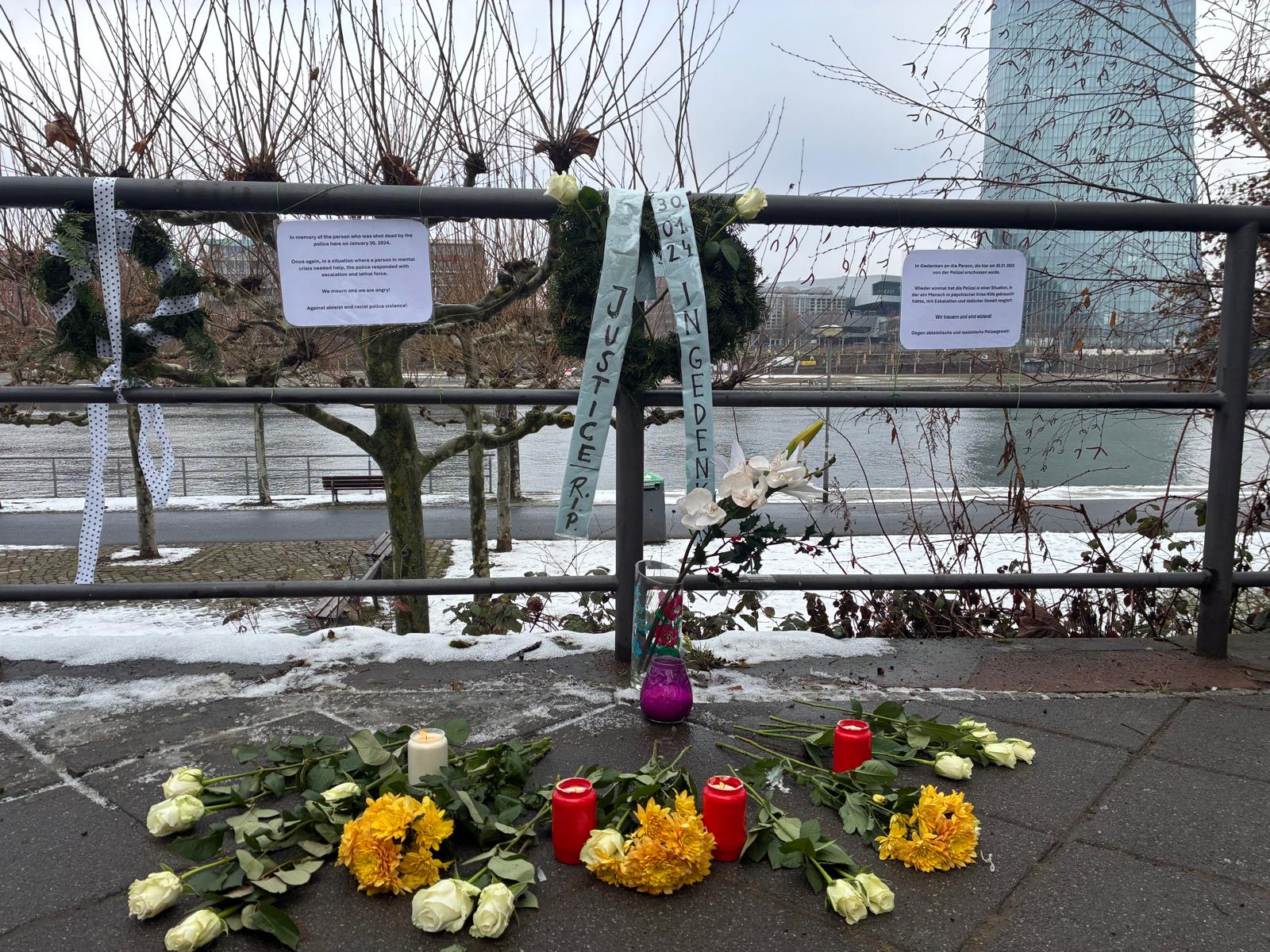
Heute, vor genau 2 Jahre am 30.01.2024, wurde ein Mann, dessen Namen wir nicht kennen, am Deutschherrnufer von der Frankfurter Polizei erschossen. Und noch immer gibt es keine Aufklärung!
Bereits vor einem Jahr sagte Staatsanwalt Dominik Mies, dass „zeitnah“ eine Abschlussverfügung(mit die Ermittlungen abgeschlossen wären) vorliegen würde.[1] Doch diese steht weiterhin aus. Auf unsere Nachfrage über einen Journalisten sagte die Pressestelle der Staatsanwaltschaft Frankfurt am 08.01.2026, es sei im ersten Quartal 2026 mit einer Abschlussentscheidung zu den Untersuchungen zu rechnen. Man bat um Verständnis, dass man Detailfragen erst danach beantworten könne. Dieses Verständnis haben wir nicht.
Unsere „Detailfragen“ bezogen sich u.a. auf den sehr spät vorgelegten „vorläufigen“ (!) Obduktionsbericht sowie die „unbeteiligte“ Person, die „vermutlich“ von einem Querschläger getroffen wurde. Des Weiteren fragten wir nach polizeilichen Einträgen und ob der Erschossene nicht schon in intransparenten Koordinierungstreffen von Stadt und Polizei Gesprächsthema war. Davon ist nach Erkenntnissen das Frankfurter Forum für psychische Krisenbewältigung auszugehen.
Offenbar war der Erschossene – der laut Presse in einer Einrichtung für Menschen mit psychischen Einschränkungen lebte – schon vor der tödlichen Situation durch sein Verhalten an beiden Seiten des Mainufers aufgefallen und hätte mit Messern hantiert.
Aber bei Aussagen wie „Er habe gewirkt, als habe er seine Medikamente weggeworfen“, wäre es doch interessant zu wissen, ob seine Einrichtung zu den leider sehr wenigen Einrichtungen in Frankfurt gehört, die ärztlich begleitete Medikamentenreduktion anbietet. Die fehlende Aufklärung und Unterstützung bei der Reduktion von Psychopharmaka, die sich viele Betroffene wünschen, führen leider immer wieder zu großen Problemen.
Die Situation, die der Tötung durch die Polizei vorausging, ist insgesamt Ausdruck einer schlechten Versorgung von Personen in psychischen Krisen. Anstatt zu helfen und Unterstützung zu organisieren, die auf die Bedürfnisse der Betroffenen angepasst ist, wird die Polizei gerufen. Diese eskaliert Situationen nur weiter und begegnet den Menschen mit extremer Gewalt.
Die Zahl der Polizeitoten ist in den vergangenen Jahren deutlich angestiegen. „Psychische Ausnahmesituation“ scheint immer mehr ein Freibrief dafür zu werden, einen Menschen töten zu dürfen. Das darf nicht sein!
Die repressiv-autoritären Tendenzen gegen psychisch erkrankte Menschen haben im letzten Jahr zugenommen:
Kristina Schröder, Merz u.a. mit der Behauptung „Wir können uns das (also Hilfen oder Pflege) nicht mehr leisten“
Die Taskforce PAVG =„Psychisch Auffällige, Vielschreiber, Gewalttäter“ im LKA
Die Änderung des PsychKHG in Hessen, wo sogar das Grundrecht auf informationelle Selbstbestimmung zeitweise zur Disposition gestellt wurde; die ambulante Zwangsbehandlung im Bund
Das umstrittene Positionspapier der DGPPN zu „Prävention von Gewalttaten“
Die Innenministerkonferenz, die mit dem Zugriff auf Patient*innendaten, sogar ohne Eigen- und Fremdgefährdung, liebäugelt.
Umgekehrt werden die Hintergründe von Gewalt von und an psychisch erkrankten Menschen nicht transparent gemacht, weder von der Stadt noch von der Justiz. Sowohl die Anfrage von Copwatch Frankfurt durch die LINKEN an den Magistrat der Stadt 2024 als auch die Anfrage des Frankfurter Forums zu den Zwangsmaßnahmen in den einzelnen Frankfurter psychiatrischen Kliniken wurde von der Stadt nur sehr ausweichend „beantwortet“.
Es bleiben Fragen offen:
Wieso haben die beteiligten Beamten in einer Situation, in der sie deeskalieren und für mehr Sicherheit sorgen sollten, einen Menschen getötet und einen weiteren verletzt?
Wieso war, der tödlichen Folge nach zu urteilen, keine Person vor Ort, die im Umgang mit Menschen in psychischen Krisensituationen erfahren und kompetent ist? Wieso wurde keine entsprechende Person hinzugezogen?
Mit welchen Vorstellungen gingen die Beamten in den Einsatz? Hat der Umstand, dass sie sich mit einer migrantischen und rassifizierten Person konfrontiert sahen, ihre Entscheidung zur Gewaltanwendung beeinflusst?
Da der getötete Mann in einer betreuten Einrichtung für Menschen mit psychischen Beeinträchtigungen lebte, stellt sich auch die Frage nach der psychiatrischen Versorgung in Frankfurt. Gab es vorab Anzeichen einer akuten Krise und wenn ja: wie wurde damit umgegangen?
Hatte auch der am Deutschherrnufer erschossene Mann mit argentinisch-spanischer Staatsangehörigkeit traumatische Erfahrungen mit Zwangseinweisungen, Fixierungen und erzwungener Behandlung in der Frankfurter Psychiatrie hinter sich?
Wir fordern
die Einrichtung eines unabhängigen, spezialisierten Krisendienstes, um Gefahrensituationen schnell und ohne Gewaltanwendung zu deeskalieren. Wir brauchen eine Alternative zur Polizei in diesen Situationen, da die eingesetzten Beamt*innen offenbar immer wieder überfordert sind und tödliche Gewalt anwenden.
eine an den Bedürfnissen von Nutzer*innen orientierte Verbesserung der therapeutischen und psychiatrischen Versorgung.
eine kritische Reflexion der Berichterstattung über Menschen mit psychischen Erkrankungen und in psychischen Krisen.
Eine konsequente Auseinandersetzung mit dem Rassismus innerhalb der Polizeibehörden und Innenministerien, anstatt das Thema immer wieder schönzureden und wegzuleugnen.
Heute wurde im Verfahren gegen Roxanne ein Urteil verkündet. Wir – der Solikreis Biriq und die Poliklinik Frankfurt – wollen das zum Anlass nehmen, staatliche Gewalt, Verwahrlosung und Zwang anzuprangern und unsere Aufmerksamkeit auf diejenigen richten, die oftmals tagtäglich davon betroffen sind. Staatliche Gewalt kann jede*n treffen. Doch wir wissen, dass all jene, die sich der zunehmend autoritären Staatlichen Ordnung nicht unterwerfen können oder wollen, besonders gefährdet sind.
Deswegen stehen wir hier für Roxanne, die als Schwarze trans Frau 17 Monate im Männerknast verbringen musste. Für Biriq, der von der Polizei in seinem Hotelzimmer im Bahnhofsviertel erschossen wurde. Für Fartoun, die in der JVA Preungesheim sterbengelassen wurde, anstatt ihre Symptome ernst zu nehmen. Für den Toten vom Main Ufer, der, statt Hilfe zu bekommen, erschossen wurde. Für alle, die täglich rassistische, ableistische oder antiziganistische Kontrollen ertragen müssen. Für diejenigen, die durch Armut an den Rand der Gesellschaft gedrängt oder dafür weggesperrt werden und die, deren Stimmen die Mauern der Zwangsunterbringung und Verwahrung nie durchbrechen können.
Wir bedanken uns bei den Freund*innen, die für die Sichtbarkeit von Roxannes Fall kämpfen und damit das Schweigen und Unsichtbar-machen nicht einfach hinnehmen. Das ist ein Schritt, der vielen zu unbequem ist. Sich schwierigen Lebensrealitäten zu stellen, die zu oft von unzähligen Rückschlägen und staatlicher Gewalt geprägt sind.
Die meisten dieser Realitäten werden wir nie sehen. Gewalt hinter den verschlossenen Türen der Knäste, in Psychiatrien und Wohneinrichtungen, in Heimen und in privaten Wohnungen bleibt unsichtbar. Und der Staat tut alles dafür, dass das so bleibt. Die Institutionen und Behörden legen die Mittel nicht offen, mit denen sie rücksichtslos für vermeintliche Ruhe und Ordnung sorgen. So werden beispielsweise in Hessen keine vollständigen Zahlen zu Zwangsmaßnahmen, die im Rahmen psychiatrischer Behandlung stattfinden, veröffentlicht – man muss sich hier wohl nicht rechtfertigen, wenn man Menschen ihrer Grundrechte beraubt.
Außerdem findet am 09. Dezember die zweite und vermutlich letzte Lesung zur Änderung des sog. „Psychisch-Kranken-Hilfe-Gesetzes“ im Hessischen Landtag statt. Am 11. Dezember soll – federführend durch SPD und CDU – beschlossen werden, dass Polizei und Ordnungsbehörden unverzüglich über die Entlassung und den Wohnsitz von Personen informiert werden müssen, die wegen einer Fremdgefährdung in der Psychiatrie untergebracht waren und bei denen davon auszugehen sei, dass durch diese Person „in absehbarer Zeit ohne ärztliche Weiterbehandlung eine erhebliche Gefahr […] ausgehen könnte“.
Weiter heißt es in der Änderung: „Zur abgestimmten Versorgungsplanung bei untergebrachten Personen, für die eine Entlassungsmeldung zu übermitteln wäre, sollen interdisziplinäre Fallkonferenzen durch das entlassende Krankenhaus unter Beteiligung des zuständigen Sozialpsychiatrischen Dienstes sowie der Ordnungs- und Polizeibehörde durchgeführt werden.“ Kurz gesagt: Die behandelnden Ärzt*innen setzen sich mit Bullen und Staat an einen Tisch, um gemeinsam die Freiheitseinschränkung der Betroffenen nach ihrer Entlassung zu planen – und das im Zweifel ohne die Betroffenen darüber in Kenntnis zu setzen. Das stellt nicht nur einen unglaublichen Einschnitt in die Selbstbestimmung und Grundrechte der Betroffenen dar, sondern stellt sie noch mehr unter den Fokus von Staat und Polizei, von deren Gewalt sie ohnehin schon überdurchschnittlich bedroht sind. Bullen und Staat haben in der Gesundheitsversorgung nichts zu suchen!
Für uns ist klar: Wer die vulnerabelsten in unserer Gesellschaft nicht schützt, schützt niemanden. Wir begreifen es daher als gemeinsame Aufgabe aller, für eine sichere und gerechte Gesellschaft zu kämpfen, ohne Knäste und Zwang. Wir fordern auf dem Weg dahin, autonome Kriseninterventions-Strukturen, um Menschen vor dem unprofessionellen, gewaltsamen und oft tödlichen Zugriff der Polizei in Krisensituationen zu schützen, Rechenschaftsberichte und unabhängige Kontrollen von psychiatrischen und staatlichen Unterbringungen, sowie den sofortigen Stopp der Änderung des sog. „Psychisch-Kranken-Hilfe-Gesetzes“.
Wir wünschen Roxanne und allen von Transfeindlichkeit, Rassismus, Knast und Psychatriesystem Betroffenen viel Kraft – there is no justice, there is just us!
Ich spreche heute für copwatchffm, eine Gruppe, die aus der Initiative Christy Schwundeck hervorgegangen ist. Christy Schwundeck ist eine Schwarze Frau, die 2011 im Jobcenter Gallus von der Polizei erschossen wurde. Sie hat ihren Regelsatz nicht erhalten und hat daraufhin beim Jobcenter nach 10 € gefragt, die ihr verwehrt wurden. Sie weigert sich, ohne die 10 € zu gehen, die Polizei wird dazugezogen, eskaliert die Situation und am Ende ist Christy Schwundeck tot. Die Täterin wurde nie zur Rechenschaft gezogen. Christy Schwundeck wurde Opfer eines Staates, das dem Leben Schwarzer Menschen weniger Wert beimisst.
Wir sind heute hier, um genau das zu skandalisieren. Wir sind heute hier in Solidarität für Roxanne, auch sie ist eine Schwarze Frau, deren Leben für den Staat weniger wert ist. Sie wurde unter dem Vorwand, über einen Job zu sprechen, in einen Keller gelockt und dort mit einem Messer angegriffen. Nach einem Kampf um Leben und Tod konnte sie dem Täter das Messer abnehmen und wehrte sich. Nach dieser krassen Gewalterfahrung musste sie für 17 Monate in Untersuchungshaft – als Frau im Männergefängnis. Nun ging ein dreimonatiger Prozess voller Schikane und Ernidrigung zu Ende, bei dem Roxanne als Angeklagte, als Täterin, als Lügnerin vorgeführt wurde.
Der ursprüngliche Vorwurf „Totschlag“ heißt: die Staatsanwaltschaft ging davon aus, dass sie ihren Angreifer vorsätzlich, also willentlich getötet habe. Erinnern wir uns an Lorenz. Er wurde im April diesen Jahres in Oldenburg von Polizisten in den Rücken geschossen. Hier wird behauptet, der Polizist habe aus Notwehr gehandelt. Während Lorenz vor ihm weggelaufen ist, soll der Bulle ihn aus Notwehr erschossen haben? Das war keine Notwehr! Immer wieder müssen wir in unserer Arbeit der Begleitung Betroffener rassistischer Polizeigewalt erleben, wie sich Menschen aufgrund eigener Gewalterfahrungen vor Gericht verantworten. Opfer werden zu Täter*innen konstruiert. So auch bei Roxanne! Der Grundsatz „Im Zweifel für die Angeklagte“ ist eine Farce, wenn institutionalisierter Rassismus, Sexismus und Transfeindlichkeit Zweifel an der Glaubwürdigkeit Schwarzer trans Personen streut!
Das sogenannte Rechtssystem ist nicht neutral, genauso wenig wie es die Polizei ist. Sie sind beide Instrumente der Gewalt, die im Dienst eines Staates stehen, der auf Rassismus, Kolonialismus, Patriarchat und kapitalistischer Ausbeutung basiert.
Die rassistische, sexistische und transfeindliche Logik vor Gericht wird in Roxannes Fall deutlich spürbar: Diskriminierende Denkmuster von Richter und Staatsanwalt werden auf Roxanne projiziert. Ihr wir systematisch nicht geglaubt. In ihrer Logik seien Schwarze trans Frauen im Bahnhofsviertel nur zu Sexarbeit fähig – das aber zu bestreiten stellt die gesamte Glaubwürdigkeit in Frage. Immer wieder wird sie als Täterin oder Lügnerin dargestellt, immer wieder wird ihr ihre Wahrnehmung abgesprochen. Das Frau-Sein wird ihr aberkannt, indem sie konstant misgendert wird. Und als Schwarze Person im Knast zu sein – das haben wir bei Nelson gesehen – ist lebensgefährlich. Als Schwarze trans Frau im Männerknast zu sein, fügt eine weitere lebensgefährliche Komponente dazu.
In der Verbindung von Rassismus und Transfeindlichkeit verstärkt sich die Repression von Staat und Polizei. Eine Studie in den USA fand heraus, dass 47 % aller Schwarzen trans Personen schon einmal inhaftiert waren.
Das liegt nicht daran, dass Schwarze trans* Personen krimineller sind, sondern daran, dass die Polizei sie wesentlich häufiger kriminalisiert, kontrolliert und schikaniert. Es geht um die Angst auf der Straße, die Betroffene erleben, um die Unsicherheit in psychischen Krisen, die selbst Produkt dieses rassistischen und queerfeindlichen Systems sind. Die emotionale und finanzielle Erschöpfung, die aufgrund von Prozessen erlitten wird, wenn sich gegen die Schikane der Polizei gewehrt wird. Es geht um die körperlichen Wunden durch Kontrollen, Knüppel und Festnahmen; über seelische Narben, die viele unserer Geschwister und und unsere Communities tragen – weltweit. Es geht um die Angst, die betroffene trans Personen haben müssen, nicht nur im Knast zu sitzen, sondern wie Roxanne als Frau im Männergefängnis sitzen zu müssen.
Dabei sind Knäste keine Orte der Resozialisierung, sie sind Orte der Isolation, Gewalt und Zerstörung. Fartoun Ali Haroun starb letztes Jahr in der JVA in Frankfurt an einer Lungenembolie. Das wollte aber niemand erkannt haben. Ihr Leiden wurde als hysterisch und/oder aufgrund ihrer psychischen Erkrankung abgetan. Sie hätte nicht sterben müssen, hätte man sie nicht entmenschlicht, eingesperrt und ihr medizinische Versorgung verweigert.
Roxanne wurde heute freigesprochen, sie muss nicht mehr im Knast sitzen. Allerdings soll sie in einer psychiatrischen Zwangsmaßnahme untergebracht werden. Sie habe eine Persönlichkeitsstörung und soll sich die Gefahrensituation aufgrund traumatischer Erfahrungen eingebildet haben. Wir sehen wieder: dieses System pathologisiert und entmenschlicht insbesondere Schwarze trans Frauen. Das Wegsperren von Menschen, ob in Kliniken oder in Knästen, bringt keine Sicherheit!
Auch die Polizei ist keine Sicherheit, nicht das Bestrafen, das Wegsperren oder Abschieben bestimmter Menschen. Was wir brauchen sind transformative Alternativen ohne Polizei und Gefängnisse, Lager und Grenzen! Sicherheit entsteht durch Solidarität, durch bezahlbaren Wohnraum, gegenseitige Fürsorge, mehr und zugänglichere Mental Health Angebote und Community.
Wir werden den Rassismus der deutschen Polizei und der Justizbehörden nicht hinnehmen und weiter gegen ihre Gewalt kämpfen! Lasst uns gemeinsam den rassistischen, ableistische und queerfeindlichen Normalzustand bekämpfen, Polizei und Gerichte kritisch beobachten und solidarisch sein mit den Betroffenen solcher Gewalt.
Seit über einem Jahr begleiten wir den Fall einer Schwarzen, migrantischen trans Frau, die häusliche Gewalt erfahren hat und von der Polizei im Stich gelassen wurde – nicht nur das, sie wurde von der Polizei ins Lächerliche gezogen, nachdem sie diese um Unterstützung rief.
Wir sammeln Geld, damit sie davon ihre Anwaltskosten, Mietkosten und Reisekosten zahlen kann – denn nach den Erfahrungen, die diese Person machen musste, kann und will sie nicht mehr langfristig in Deutschland bleiben.
Mittlerweile wohnt sie nicht mehr im gemeinsamen Haushalt mit ihrem Ex Mann und befindet sich im Scheidungsprozess. Nachdem sie hierfür Prozesskostenhilfe erhalten hatte, musste sie ihre Anwältin wechseln, da es dieser an zwischenmenschlichen Kompetenzen fehlte, um mit ihrer Klientin umzugeben. Auf Antrag kann bei wichtigen Gründen die Prozesskostenhilfe auf eine neue Anwaltsperson übertragen werden; dies wird – wie auch in ihrem Fall – zwar oft abgelehnt, doch die schriftliche Begründung hat auch uns schockiert: es liege kein wichtiger Grund vor, da »ein Gespräch über die rechtlichen Voraussetzungen des geltend gemachten Anspruchs nur dann möglich ist, wenn die Antragstellerin nicht das gesamte Gespräch über weint« (Dokument liegt Copwatchffm vor). Einer Person, die Folgesymptome eines Gewaltereignisses zeigt, wird so der Zugang zum Recht verwehrt.
Unsere Freundin benötigt also erstens Geld für eine Familienrechtler*in. Zweitens benötigt sie Geld für eine Anwaltsperson im Migrationsrecht. Ihr Ex Mann behauptet nun, dass die Ehe eine Scheinehe gewesen wäre zur Erschleichung eines Aufenthaltsrechts. Und drittens möchte sie, nachdem alles erledigt ist Deutschland verlassen und benötigt hierfür finanzielle Unterstützung für Reisekosten.
Nach den traumatischen Erfahrungen, die sie in Deutschland machen musste, all der Gewalt und dem Gaslighting, kann sie sich eine Zukunft in diesem Land nicht länger vorstellen.
Bitte unterstützt wenn ihr könnt finanziell und/oder teilt den Aufruf gerne in euren Netzwerken.
All das, was zusätzlich eingenommen wird, geht an uns, also Copwatch Frankfurt und hilft uns dabei langfristig betroffenen von rassistischer Polizeigewalt zu unterstützen.
For over a year, we have been following the case of a Black, migrant trans woman who experienced domestic violence and was abandoned by the police—not only that, she was ridiculed by the police after calling them for help.
We are raising money so that she can pay her legal fees, rent, and travel expenses—because after the experiences this person has had to endure, she can no longer and no longer wants to stay in Germany long-term.
She no longer lives with her ex-husband and is in the process of getting a divorce. After receiving legal aid for this, she had to change her lawyer because the lawyer lacked the interpersonal skills to deal with her client. Upon request, legal aid can be transferred to a new lawyer for important reasons; although this is often rejected, as in her case, the written justification shocked us: there was no important reason, as “a discussion of the legal requirements of the claim asserted is only possible if the applicant does not cry throughout the entire conversation.” (document available to Copwatchffm). A person showing symptoms of trauma following an act of violence is thus denied access to justice.
Firstly, our friend needs money for a family lawyer. Secondly, she needs money for a lawyer specializing in immigration law. Her ex-husband now claims that the marriage was a sham marriage to obtain a residence permit. And thirdly, once everything is settled, she wants to leave Germany and needs financial support for travel expenses.
After the traumatic experiences she had to endure in Germany, all the violence and gaslighting, she can no longer imagine a future in this country.
Please support us financially if you can and/or share this call in your networks.
All additional funds raised will go to us, Copwatch Frankfurt, and will help us to support those affected by racist police violence in the long term.
Copwatch Frankfurt hat den Fall einer Schwarzen karibischen trans Betroffenen begleitet, der zeigt, wie häusliche und staatliche Gewalt zusammenwirken.
Wir, Verein für interkulturelle Alltagspraxis (Vereinssitz: Deutschland), verarbeiten zum Betrieb dieser Website personenbezogene Daten nur im technisch unbedingt notwendigen Umfang. Alle Details dazu in unserer Datenschutzerklärung.
Wir, Verein für interkulturelle Alltagspraxis (Vereinssitz: Deutschland), verarbeiten zum Betrieb dieser Website personenbezogene Daten nur im technisch unbedingt notwendigen Umfang. Alle Details dazu in unserer Datenschutzerklärung.